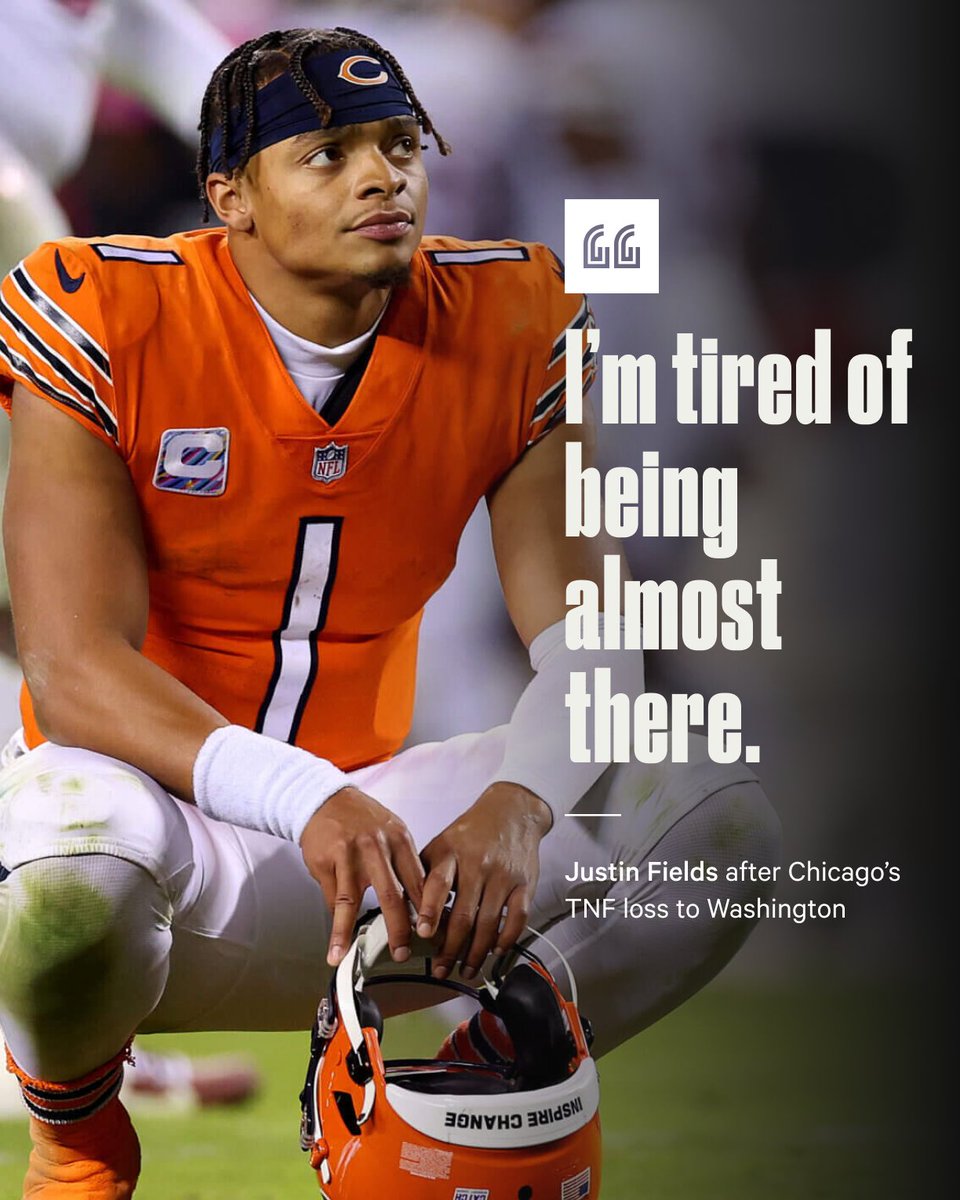
Justin Fields and the Chicago Bears: A Story of Failure, Mismanagement, and a Rewritten Narrative
The story has already been written. Before the first snap in Pittsburgh, before the first pass even left his hand, the verdict had been delivered in the court of public opinion. Justin Fields had become the label more than the player—bust, inconsistent, too slow processing the field, holding the ball too long. And in March 2024, the Chicago Bears closed the book, trading him away for what many considered a minimal return: a conditional sixth-round pick.
But that simple headline hides a far more complicated truth.
A Franchise Searching for a Savior
When the Bears traded up in the 2021 NFL Draft to select Fields with the 11th overall pick, the move was framed as the arrival of a long-awaited franchise quarterback. Fields was a five-star recruit, a Heisman finalist, and a dominant force at Ohio State, combining elite athleticism with one of the strongest arms in the draft class.
For a fanbase starving for stability at quarterback, he represented hope.
But hope collided immediately with dysfunction.
A Rookie Set Up to Fail
Head coach Matt Nagy entered the 2021 season under immense pressure. Despite his reputation as an offensive mind, his system was already fracturing. Rather than fully committing to developing Fields, Nagy publicly named Andy Dalton the starter and limited Fields’ first-team reps throughout training camp.
When Fields finally took over, the transition was abrupt. Thrown into a Week 2 matchup against the Cleveland Browns, he was sacked nine times in one of the most hostile rookie debuts in recent memory.
The issue was not just performance—it was structure. The offensive scheme provided minimal protection adjustments, limited movement-based plays, and almost no adaptation to Fields’ strengths as a dual-threat quarterback.
A Rebuild Without Support
By 2022, leadership had changed. General manager Ryan Poles and head coach Matt Eberflus were tasked with reshaping the franchise. But instead of surrounding Fields with weapons, the Bears entered a financial reset.
Key veterans departed, and the receiving corps became one of the weakest in the NFL. Fields was left to operate behind an inconsistent offensive line while throwing to a rotation of fringe receivers, including Equanimeous St. Brown, Dante Pettis, and Byron Pringle.
Advanced metrics told a clear story. According to Next Gen Stats, Chicago ranked last in receiver separation league-wide. Defenses rarely needed to adjust—coverage was often tight, and windows were nonexistent.
Fields’ high sack numbers were frequently cited as evidence of holding the ball too long. But context matters: in 2022 alone, he was sacked 55 times, posting a sack rate of 14.7%, more than double the league average.
Under constant pressure, quarterbacks begin to anticipate collapse rather than opportunity. Timing erodes. Trust in protection disappears. Development stalls.
System vs. Skill
Offensive coordinator Luke Getsy attempted to implement a structured passing system influenced by Green Bay’s West Coast roots. But instead of adapting the system to Fields, the offense often forced Fields into rigid rhythm-based concepts that did not match his strengths.
Meanwhile, designed quarterback runs—one of the most effective elements of his game—were inconsistently used. In 2022, Chicago briefly unlocked Fields’ rushing ability, and he nearly set records on the ground. But those concepts were later scaled back, leaving an identity crisis within the offense.
When the Bears finally acquired DJ Moore in 2023, the roster gap had already widened beyond immediate repair.
The Business Decision Behind the Trade
Beyond performance, the decision to move on from Fields was also financial.
By 2024, Chicago held the No. 1 overall pick after a trade with Carolina. Fields was entering the expensive portion of his rookie contract cycle, where the fifth-year option and future extension would require significant long-term financial commitment.
Drafting Caleb Williams provided something different: a reset.
A cheaper contract. A longer timeline. A fresh organizational clock.
In that context, Fields was no longer just a quarterback evaluation—he was a financial and structural decision.
Failure or Mismanagement?
The central question remains unresolved.
Did Justin Fields fail the Chicago Bears?
Or did the Chicago Bears fail Justin Fields?
His time in Chicago was defined by instability: multiple coaching systems, limited offensive talent, inconsistent development plans, and overwhelming defensive pressure. At every stage, the environment rarely aligned with his strengths.
Yet the NFL is ultimately a production league, and production defines legacy.
Conclusion: A Familiar Cycle in Chicago
Justin Fields’ departure is not an isolated story. It is part of a long-standing pattern of organizational instability within the Chicago Bears—one where quarterbacks arrive with promise and leave with unanswered questions.
Whether Fields becomes a long-term starter elsewhere or fades into another cautionary tale, his Chicago chapter reflects something larger than one player.
It reflects a franchise still searching for a modern identity—caught between potential and execution, always rebuilding, never quite arriving.