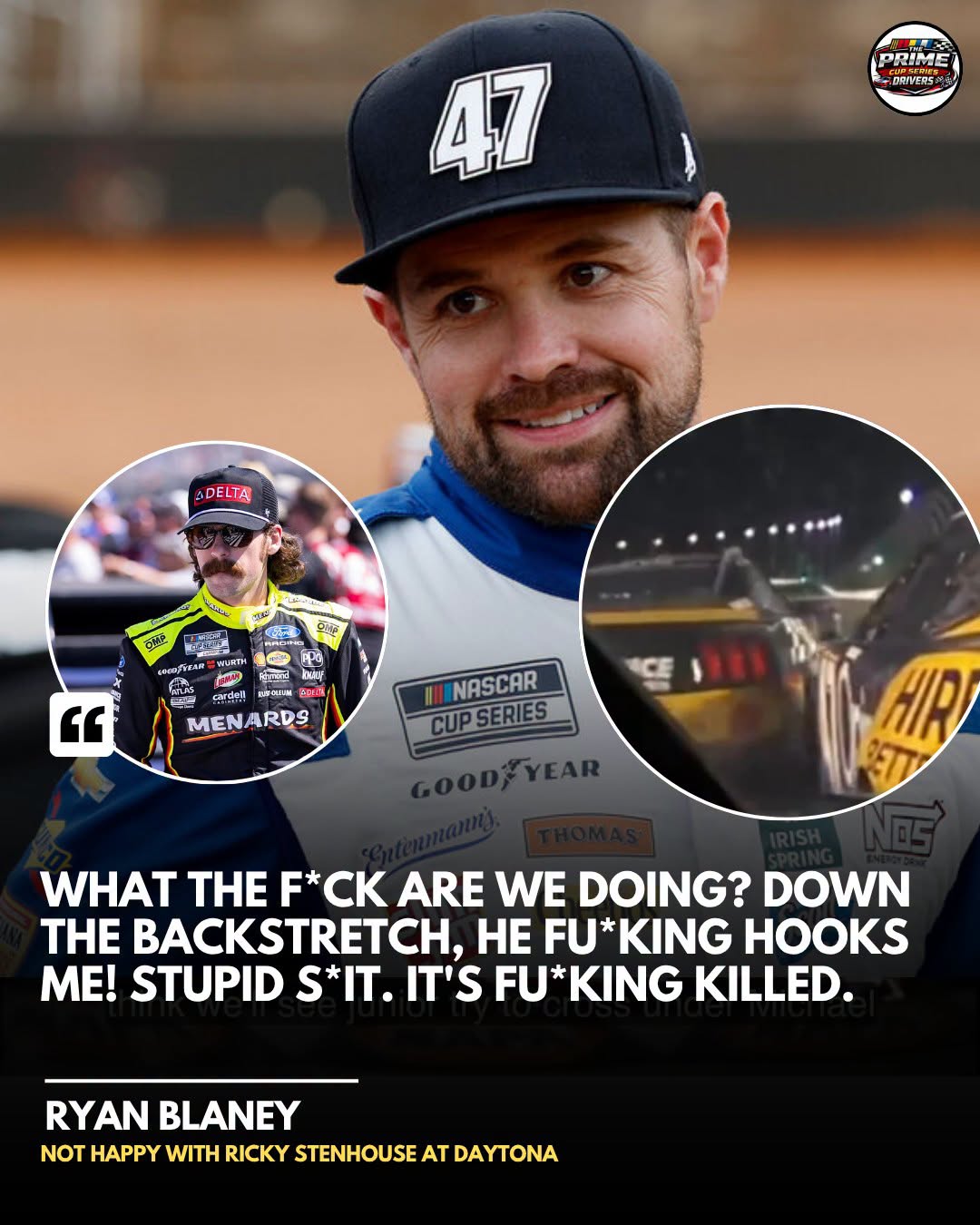
Ryan Blaney Furious After Ricky Stenhouse Jr. Contact at Daytona Turns Potential Top-Five Finish Into 33rd
Ryan Blaney appeared to be on his way to a strong finish at Daytona when a late-race incident dramatically changed his night.
What looked like a potentially valuable top-five result quickly turned into a disappointing 33rd-place finish after Blaney was involved in a final-lap incident with Ricky Stenhouse Jr. The contact sent Blaney’s No. 12 Ford hard into the outside wall, ending his hopes of a strong result and leaving him visibly frustrated over the team radio.
The incident immediately became one of the most talked-about moments of the race.
Blaney Avoids the Initial Wreck—Only to Get Collected Moments Later
As the field charged toward the finish, chaos erupted around the Daytona oval.
Blaney managed to avoid the initial wreck and appeared to have put himself in position for a strong finish. But the danger wasn’t over.
While running down the backstretch, Blaney was hit from behind by Stenhouse Jr.’s No. 47 Chevrolet. The contact sent Blaney’s car sideways and ultimately into the outside wall with significant force.
A driver who had been positioned for a potential top-five finish suddenly found himself out of contention.
The result was especially frustrating because there was so little time left for Blaney to recover.
Blaney Makes His Anger Clear Over the Radio
Immediately after the contact, Blaney did not hide his frustration.
Over the radio, he could be heard angrily questioning what had happened and accusing Stenhouse of “hooking” him.
His reaction captured just how frustrating the incident was from Blaney’s perspective. After surviving the initial chaos and positioning himself for a strong finish, the No. 12 was suddenly damaged because of contact from another car.
For Blaney, it wasn’t simply a matter of getting caught in the unavoidable chaos that often defines Daytona.
He appeared to believe Stenhouse was responsible for the contact.
The radio outburst quickly became one of the defining moments of the race, with fans debating whether Blaney had a legitimate reason to be angry or whether the incident was simply another example of how unpredictable superspeedway racing can be.
Stenhouse Continues to a Fifth-Place Finish
Adding another layer to Blaney’s frustration was the fact that Stenhouse Jr. was able to continue after the contact.
The No. 47 ultimately crossed the finish line in fifth place, while Blaney’s damaged No. 12 fell all the way to 33rd.
The contrast could hardly have been more dramatic.
One driver walked away with a top-five result, while the other was left wondering what could have been.
At Daytona, however, drivers know that positions can disappear in an instant. The tightly packed racing, drafting and constant three-wide battles mean that even the smallest contact can produce a massive consequence.
For Blaney, that consequence was particularly costly.
Was Stenhouse Too Aggressive?
The biggest question coming out of the incident is whether Stenhouse was simply racing aggressively or crossed the line with the contact.
From Blaney’s perspective, the answer appeared obvious.
His immediate reaction suggested that he believed Stenhouse’s move was more than ordinary Daytona contact. The accusation that Stenhouse “hooked” him indicates that Blaney felt the No. 47 made contact in a way that intentionally or unnecessarily turned his car.
But superspeedway racing is rarely that simple.
Drivers run extremely close together at Daytona, often with only inches separating cars traveling at high speeds. Bumpers touch, cars move within the draft and small changes in momentum can quickly send one vehicle into another.
That makes it difficult to determine intent from the result alone.
Stenhouse may have been attempting to make a move, maintain momentum or avoid another car when the contact occurred. Alternatively, Blaney’s interpretation may be that the contact was avoidable and unnecessarily aggressive.
Either way, the outcome was undeniable.
Blaney paid the biggest price.
Daytona Chaos Once Again Decides the Finish
The incident serves as another reminder of why Daytona remains one of the most unpredictable tracks on the NASCAR schedule.
A driver can run near the front for almost the entire race, avoid multiple incidents and still have his night ruined within seconds.
Blaney seemed to have done almost everything necessary to put himself in position for a strong result. He survived the initial wreck and was still in contention as the field raced toward the checkered flag.
Then came the contact with Stenhouse.
One moment, a top-five finish was within reach.
The next, Blaney was in the wall.
That kind of swing is part of what makes superspeedway racing so exciting for fans—and so frustrating for drivers.
A Costly Result for Blaney
Finishing 33rd instead of potentially finishing inside the top five could have significant implications, particularly if the result affects the championship picture and playoff momentum.
Every position matters during a NASCAR season, and Daytona can produce some of the biggest swings of the year.
For Blaney and his team, the frustration is likely to be amplified by how close they were to turning the race into a successful night.
Instead, they were left with a damaged race car, a disappointing result and plenty of questions about the contact with Stenhouse.
The No. 12 team will now have to put the incident behind them and focus on the races ahead.
Fans Debate Who Was at Fault
As footage and radio audio circulated, fans quickly divided into two camps.
Some sided with Blaney, arguing that Stenhouse was too aggressive and that the contact unnecessarily destroyed a strong finish.
Others viewed the incident as standard Daytona racing, where drivers are constantly making split-second decisions while traveling at extremely high speeds in tightly packed traffic.
That debate is unlikely to disappear anytime soon.
There is also an undeniable irony in the final result: Stenhouse finished fifth, while Blaney ended up 33rd after the contact between the two cars.
For Blaney, the numbers tell the story of a night that changed dramatically in just a few seconds.
The Bottom Line
Ryan Blaney’s frustration at Daytona was understandable.
After avoiding the initial wreck and positioning himself for what appeared to be a potential top-five finish, his race came undone when Ricky Stenhouse Jr. made contact with the No. 12 down the backstretch.
Blaney immediately voiced his anger, accusing Stenhouse of “hooking” him, while Stenhouse went on to finish fifth.
Whether the contact was an overly aggressive move or simply another product of Daytona’s unpredictable racing is still open to debate.
But one thing is certain: Blaney won’t be happy about watching a potential top-five finish turn into 33rd on the final lap.
And with the championship picture always in the background, the consequences of one moment at Daytona could prove much bigger than the frustration of a single race.
Was Ricky Stenhouse Jr. too aggressive, or was Ryan Blaney simply another victim of Daytona chaos?