Skinwalker Ranch and the Secret Pentagon UFO Program: The Strange Story Behind America’s Search for the Unknown
In March 2007, Jim Lacatski, a physicist and senior intelligence analyst at the U.S. Defense Intelligence Agency, traveled to northeastern Utah.
He was not a paranormal investigator. He was not known as a UFO enthusiast. His professional background was rooted in physics, intelligence analysis and ballistic missile technology. By his own account, he had spent his career dealing with phenomena that could be measured, tested and explained.
Then, inside a small house on a remote Utah ranch, he saw something he could not explain.
For roughly 30 seconds, Lacatski reportedly watched a strange, semi-transparent, yellowish object hovering several feet above the floor. It appeared tubular, almost mechanical, like a piece of industrial equipment suspended in midair.
There was no obvious source.
No sound.
No visible means of support.
And, according to Lacatski, none of the other people in the room appeared to notice it.
Then it disappeared.
What happened next would help set in motion one of the most unusual and controversial investigations ever funded by the U.S. government—an investigation that examined UFOs, unusual aerospace technology, reports of paranormal activity and the mysterious phenomena associated with a remote property known as Skinwalker Ranch.
But to understand how a senior government scientist ended up staring at an apparently impossible object in a Utah kitchen, it is necessary to go back decades.
The Legend of Skinwalker Ranch
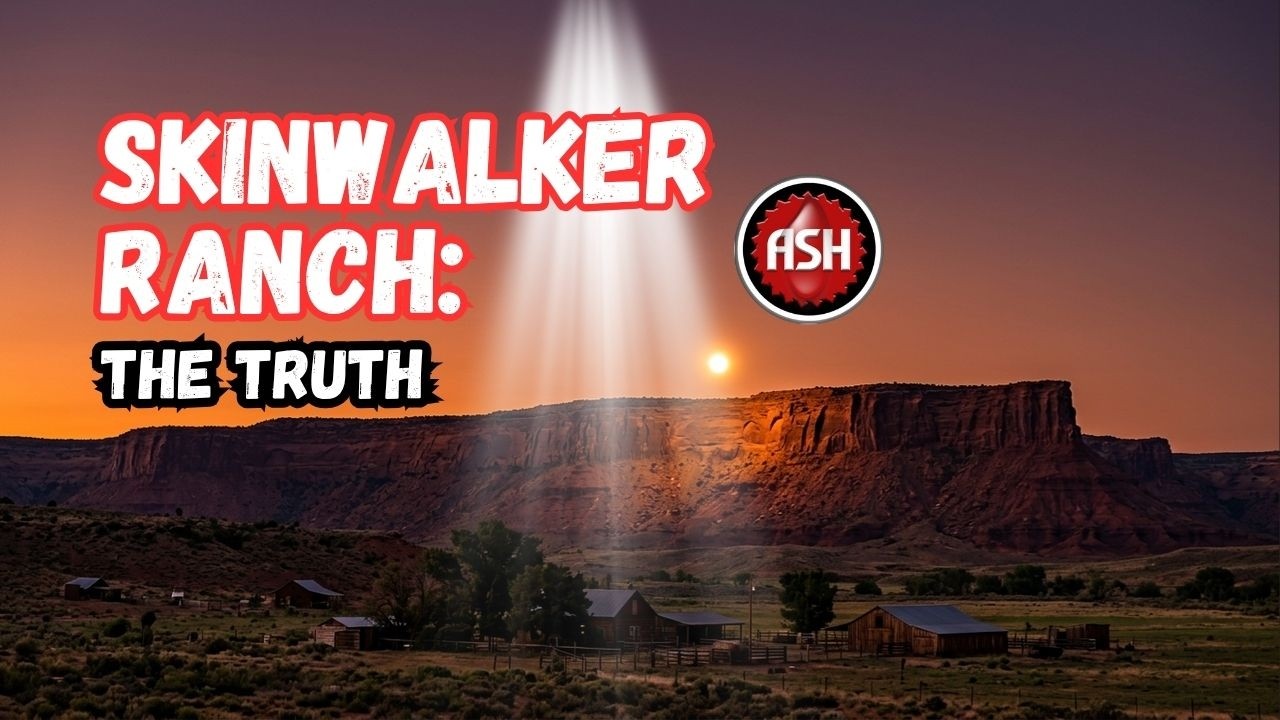
Skinwalker Ranch sits in Utah’s Uinta Basin, near the Ute reservation.
Long before the property became associated with UFOs and government investigations, the surrounding region had its own traditions and stories concerning supernatural beings.
One of the most famous is the legend of the skinwalker, a figure associated in Navajo tradition with witchcraft and supernatural transformation. The modern story surrounding the ranch often connects this tradition with a particular area of land that some local Native American traditions regard with fear and caution.
It is important to distinguish traditional beliefs from later paranormal claims. There is no scientific evidence establishing that a supernatural curse exists on the property.
Nevertheless, the legend became an important part of the ranch’s modern mythology.
Then, in the 1990s, a family moved onto the property.
Their names were Terry and Gwen Sherman, although they were given pseudonyms in the book Hunt for the Skinwalker.
The Shermans were ranchers. They bought the property expecting a quiet life and an opportunity to raise cattle.
Instead, they reported a series of increasingly disturbing incidents.
At first, the events were relatively mundane: locks appeared to have been opened, animals behaved strangely and the family’s dogs seemed terrified of a particular area of the barn.
Then the stories became much harder to explain.
The Giant Wolf
According to the Shermans’ accounts, one of the earliest dramatic incidents involved a creature that emerged from the tree line.
It reportedly resembled a wolf—but was far larger than an ordinary wolf.
The animal approached the cattle and grabbed a calf through the bars of a corral.
Terry Sherman reportedly attempted to drive it away.
He kicked it. He struck it with a piece of wood. When that failed, he fired at it.
According to his account, bullets appeared to have little effect.
The creature eventually released the calf and disappeared toward the trees.
Sherman later reported finding tracks in the ground—but the trail seemingly ended abruptly.
To believers, this became one of the earliest indications that something extraordinary was happening on the property.
To skeptics, it remains an extraordinary story without independently verifiable evidence.
The distinction matters because much of the Skinwalker Ranch narrative rests on eyewitness testimony, retrospective accounts and investigations whose conclusions remain disputed.
Cattle, Missing Animals and Strange Lights
The reports continued.
Cattle were allegedly found mutilated in ways that did not resemble ordinary predator attacks. Some carcasses reportedly displayed missing tissue without the expected blood trails or tracks.
One particularly bizarre account involved four valuable bulls.
According to the Shermans, the animals disappeared and were later discovered packed inside a horse trailer.
The circumstances seemed physically implausible to the family.
Then came the incident involving the dogs.
In 1996, Sherman reportedly saw a blue sphere of light moving across the property. He sent his dogs after it.
The animals disappeared into the vegetation.
The next morning, Sherman allegedly found circular areas of dead grass and dark material where the dogs had been.
These stories became central to the ranch’s reputation.
But there was another detail that made the case particularly unusual: despite the alleged violence against animals, the family members themselves reportedly remained physically unharmed.
By the summer of 1996, the Shermans had had enough.
They sold the ranch and left Utah.
Their buyer was a wealthy businessman from Las Vegas named Robert Bigelow.
Robert Bigelow Enters the Story
Robert Bigelow had already developed a fascination with unexplained phenomena.
According to accounts about his family, Bigelow’s interest in UFOs dated back to a story told by his grandparents involving a strange ball of light encountered while driving in Nevada.
Bigelow eventually became a successful businessman and accumulated a considerable fortune.
Rather than simply speculate about paranormal phenomena, he decided to investigate them.
In 1995, he established the National Institute for Discovery Science, or NIDS.
The organization was deliberately different from the stereotypical image of amateur UFO investigators.
Its associates included scientists, engineers, intelligence professionals and individuals with military backgrounds. Among those connected to the organization were physicist Hal Puthoff, Army Colonel John Alexander and astronaut Edgar Mitchell.
When Bigelow purchased the ranch in 1996, he transformed it into a research site.
Cameras were installed.
Scientists monitored the property.
Security personnel were employed.
The ranch effectively became a laboratory dedicated to studying reports of extraordinary phenomena.
And according to the investigators, the phenomena did not stop.
When the Investigators Became the Observed
One of the most intriguing aspects of the NIDS investigation was the alleged behavior of the phenomena around surveillance equipment.
Researchers reported cameras malfunctioning or losing power unexpectedly.
Some equipment allegedly behaved in ways that investigators could not immediately explain.
In one account, a camera was reportedly found operating in a mode that required manual intervention.
Investigators also reported strange lights, unusual creatures and unexplained environmental effects.
One of the most famous accounts came in March 1997.
According to the investigators, witnesses observed what appeared to be a large creature in a tree. It reportedly had unusual yellow eyes and a massive head.
Another animal was allegedly seen near the base of the tree.
A shot was fired.
The creature supposedly disappeared.
Only a strange three-toed track was reportedly found in the snow.
None of these observations has established the existence of an unknown species or supernatural creature. But they became part of the growing body of reports that made Skinwalker Ranch famous.
The Ranch Becomes a Government Problem
The significance of Skinwalker Ranch changed when its story reached Washington.
One of the people who became interested was Nevada Senator Harry Reid.
Reid had a long-standing interest in unexplained aerospace phenomena and maintained a relationship with Bigelow.
By the 2000s, reports of unidentified objects near sensitive military installations were also becoming increasingly difficult for officials to ignore.
This was a different question from whether ghosts or monsters existed.
The national-security question was simpler:
What were military pilots seeing in restricted airspace?
If unidentified objects were operating near nuclear facilities or military installations, the government needed to know what they were—even if the ultimate explanation turned out to be completely conventional.
That framing proved crucial.
The $22 Million UFO Program
In 2007, Lacatski reportedly visited Skinwalker Ranch.
His experience there became part of a chain of events that eventually led to the creation of a classified Pentagon investigation.
The program is generally associated with the Advanced Aerospace Weapon System Applications Program, or AAWSAP.
Congress provided approximately $22 million for the effort.
Senator Harry Reid played a central role in securing the funding, working alongside Senators Daniel Inouye and Ted Stevens.
The project was administered through the Defense Intelligence Agency.
Its official purpose concerned advanced aerospace threats and unexplained aerial phenomena.
But the scope of the work became extraordinarily broad.
Researchers examined reports of UFOs, unusual aerospace technology and alleged anomalous events associated with Skinwalker Ranch.
The government was now spending millions of dollars investigating phenomena that, only a few years earlier, would have been dismissed by many officials as fringe material.
Bigelow Aerospace and the Controversial Contract
The program required a contractor.
In 2008, the government issued a solicitation for the work.
Bigelow Aerospace Advanced Space Studies, or BAASS, ultimately received the contract.
The connection was controversial.
Bigelow owned the ranch.
He had previously funded paranormal research.
And now a company connected to him was being paid to conduct work related to phenomena that had helped generate his own interest in the subject.
Critics saw an obvious potential conflict of interest.
Supporters argued that Bigelow’s existing infrastructure and experience made his organization uniquely qualified to conduct the work.
Whatever one’s interpretation, the arrangement became an important part of the controversy surrounding the program.
A Database of Unidentified Phenomena
BAASS did not focus exclusively on Skinwalker Ranch.
It also assembled an enormous database of reports involving unidentified aerial phenomena.
Researchers examined historical military records, civilian reports and international cases.
The goal was to determine whether patterns existed across decades of unexplained sightings.
One case that attracted considerable attention was the 2004 encounter involving U.S. Navy pilots off the coast of California.
The event would later become known as the “Tic Tac” incident.
Pilots reported encountering an unusual object without visible wings or conventional propulsion.
The object appeared capable of extraordinary acceleration and maneuverability.
Years later, infrared video of the encounter became public.
The Pentagon eventually acknowledged the authenticity of the videos, while emphasizing that the objects themselves remained unidentified.
That distinction is critical.
Unidentified does not automatically mean extraterrestrial.
An object can be unidentified because there is insufficient information to determine what it was.
Nevertheless, the Tic Tac encounter became one of the defining cases in the modern UFO debate.
The 38 Technical Reports
One of the most remarkable elements of the government program was the production of a series of technical reports known as Defense Intelligence Reference Documents, or DIRDs.
The subjects were extraordinary.
Researchers examined concepts including advanced propulsion, invisibility, anti-gravity, warp drives, wormholes and other theoretical technologies.
Some reports explored highly speculative physics.
That fact has frequently been misrepresented as evidence that the Pentagon had proven such technologies existed.
It did not.
A government-funded technical study asking whether a technology might theoretically be possible is not the same thing as demonstrating that the technology exists.
Nevertheless, the fact that government funding was used to examine such concepts reveals how seriously officials were willing to investigate unconventional possibilities.
The Human Cost
The most disturbing part of the story was not necessarily UFO propulsion or wormholes.
It was the alleged effect of anomalous phenomena on human beings.
One report examined alleged biological effects associated with encounters with unusual phenomena.
Physician and intelligence consultant Christopher “Kit” Green became associated with this research.
The work reviewed cases involving people who claimed to have suffered burns, radiation-like symptoms and other physical effects following alleged encounters.
Some cases were described as medically unusual.
Others were highly speculative.
The existence of these reports does not establish that extraterrestrial craft caused the injuries.
In fact, Green later expressed uncertainty about whether some alleged injuries could have resulted from human technology rather than extraterrestrial sources.
Nevertheless, the government-funded investigation considered the possibility that unexplained phenomena could pose a biological or medical risk.
And then came one of the strangest claims associated with Skinwalker Ranch.
The “Hitchhiker Effect”
Investigators began reporting what became known as the “hitchhiker effect.”
The basic idea was that anomalous experiences did not always remain at the ranch.
According to some accounts, individuals who visited the property later reported strange events in their own homes.
Lights.
Sounds.
Apparitions.
Unexplained objects.
Disturbances experienced by family members.
The phenomenon, according to these reports, appeared to follow people away from the ranch.
Some researchers began describing the effect almost as though it were an infection or an environmental exposure.
One investigator, according to accounts later published about the program, reportedly experienced unusual events in his home thousands of miles from Utah.
His family allegedly began seeing and hearing things.
For those involved, this transformed the question.
It was no longer simply:
What is happening at Skinwalker Ranch?
It became:
Can whatever is happening there follow people home?
There is no established scientific evidence demonstrating that such a phenomenon exists. But the claims became important enough within the program to appear in discussions of potential human-health consequences.
From UFOs to “Stargates”
The program’s research went even further into theoretical territory.
Some reports explored wormholes, negative energy and hypothetical methods of manipulating spacetime.
One report examined theoretical concepts sometimes described in popular culture as “stargates.”
Again, these were theoretical studies.
Scientists can calculate whether certain physical scenarios are mathematically possible without having evidence that anyone has actually built them.
Nevertheless, the subject matter was astonishing for a government program that was supposedly investigating unidentified aerospace threats.
The same organization was examining UFO reports, advanced propulsion, human biological effects and theoretical spacetime engineering.
It was becoming difficult to describe the project as a conventional defense study.
Why the Program Was Shut Down
By 2010, the program was coming to an end.
Senator Reid reportedly attempted to secure greater protection for the project by seeking Special Access Program status.
That request was rejected.
Among the concerns was the fact that the program’s work was largely unclassified and that its contractor had not established the secure infrastructure necessary for such a highly restricted program.
There was also concern about the project’s unusual subject matter.
According to journalists and former participants, some officials reportedly regarded the paranormal aspects of the research as deeply problematic.
Some allegedly viewed the subject through a religious framework, believing that UFO and paranormal phenomena could have demonic rather than extraterrestrial origins.
Whether this played a decisive role in the program’s demise remains disputed.
What is clear is that AAWSAP did not continue in the form originally envisioned.
By the end of 2010, the program was effectively finished.
The Public Learns About the Pentagon’s UFO Program
For years, the public knew almost nothing about what had happened.
Then, in December 2017, The New York Times published a landmark investigation revealing the existence of a secret Pentagon UFO program.
The story focused heavily on a program called the Advanced Aerospace Threat Identification Program, or AATIP.
The revelation transformed the public conversation about UFOs.
Military pilots were talking openly.
Videos of unidentified objects were released.
The Pentagon acknowledged that it had investigated such cases.
But the relationship between AATIP and AAWSAP has remained a source of confusion.
The two programs are often treated as interchangeable, but their histories and administrative structures were not identical.
This distinction matters because the Skinwalker Ranch research was primarily associated with AAWSAP and BAASS, while the public revelation in 2017 largely focused on AATIP.
The result was that much of the strangest material remained obscure even after the existence of a Pentagon UFO program became public knowledge.
The Release of the Reports
Researchers and journalists continued filing Freedom of Information Act requests.
Eventually, the Defense Intelligence Agency released most of the 38 technical reports associated with the program.
Thirty-seven were ultimately made public, while one remained withheld.
The documents offered an unusual glimpse into what government-funded researchers had actually been studying.
They did not prove that aliens had visited Earth.
They did not establish the existence of portals.
They did not demonstrate that Skinwalker Ranch was a supernatural gateway.
But they confirmed something far less sensational—and arguably more significant:
The U.S. government really did spend substantial money studying phenomena that had previously been dismissed as fringe subjects.
From AAWSAP to AARO
The government’s investigation of unidentified phenomena did not end in 2010.
In 2022, the Department of Defense established the All-domain Anomaly Resolution Office, or AARO, to investigate unidentified anomalous phenomena across multiple domains.
AARO later published a historical report examining claims about secret UFO programs and alleged extraterrestrial technology.
Its conclusions were skeptical.
The office found no verifiable evidence that the U.S. government had confirmed extraterrestrial technology or successfully reverse-engineered alien spacecraft.
That position stands in sharp contrast to claims made by some former intelligence personnel.
Among the most prominent is David Grusch, who testified before Congress that he had been informed about alleged long-running programs involving the recovery and reverse engineering of non-human craft.
Grusch’s claims generated enormous attention.
But allegations remain allegations unless independently verified.
And that is where the story becomes particularly difficult.
Kona Blue and the Claims of “Non-Human Biologics”
A 2024 government report revealed another fascinating chapter.
A proposed Department of Homeland Security program known as Kona Blue was reportedly envisioned as a potential successor effort.
The proposal involved alleged recovery and analysis of unusual materials and what were described as “non-human biologics.”
The proposal was ultimately rejected.
There is an important distinction here as well: the existence of a proposal does not establish the truth of the extraordinary claims contained within it.
Government officials can propose investigations into claims that later prove to be incorrect.
Nevertheless, the existence of the proposal demonstrates how seriously some individuals within government were willing to consider the possibility of recovering unknown materials.
What Jim Lacatski Says He Saw
That brings the story back to Jim Lacatski.
The man who reportedly stood inside a ranch house in 2007 and watched an unexplained object hover in the air later became a central figure in the government investigation.
In later accounts, Lacatski made an extraordinary claim: that the United States had obtained access to a craft of unknown origin.
According to his description, the object appeared designed to fly but lacked many of the features normally associated with conventional aircraft.
No obvious wings.
No conventional engine.
No exhaust.
No apparent fuel system.
The question, Lacatski reportedly asked, was simple:
What is it for?
If true, that would be one of the most extraordinary technological discoveries in modern history.
But the public has never been given independently verifiable evidence sufficient to establish that such a craft exists.
And that distinction remains at the heart of the entire Skinwalker Ranch story.
What Do We Actually Know?
After decades of stories, investigations, government programs and conflicting testimony, several facts can be established.
Skinwalker Ranch exists.
The Sherman family lived there and reported extraordinary events.
Robert Bigelow purchased the property and funded extensive investigations.
NIDS conducted research there.
The U.S. government funded AAWSAP.
BAASS received the contract to perform much of the work.
The government produced technical reports on highly unconventional aerospace and physics concepts.
Military personnel have reported encounters with unidentified objects.
The Pentagon has acknowledged investigating UAP.
AARO continues to investigate unexplained phenomena.
And former officials have made extraordinary claims about recovered craft and non-human materials.
What has not been established is equally important.
There is no publicly verified evidence proving that Skinwalker Ranch is a portal.
There is no independently confirmed evidence that aliens have visited the ranch.
There is no publicly verified evidence that supernatural entities followed investigators home.
There is no publicly demonstrated proof that the U.S. government possesses extraterrestrial spacecraft.
And there is no scientific consensus that the phenomena reported at Skinwalker Ranch have a single cause.
The Real Mystery
Perhaps the most compelling part of the Skinwalker Ranch story is not whether the ranch contains aliens, monsters, interdimensional beings or something supernatural.
It is the fact that serious institutions were willing to investigate questions that had long been considered too strange to ask.
A physicist walked into a remote Utah house and claimed to see something impossible.
A billionaire decided to investigate.
Scientists and intelligence officials spent years collecting reports.
Congress secretly allocated millions of dollars.
Military personnel documented unexplained objects.
Researchers explored theoretical propulsion systems and biological effects.
And eventually, the government created an entire office dedicated to resolving unidentified phenomena.
Yet after all that effort, the fundamental question remains unanswered.
What exactly were they looking at?
Perhaps the answer will eventually turn out to be conventional—misidentified aircraft, classified technology, atmospheric phenomena, psychological effects, equipment failures and stories that became more extraordinary with every retelling.
Perhaps some cases will remain genuinely unexplained.
And perhaps, as some witnesses insist, there is something far stranger behind the phenomenon.
But the evidence available to the public does not allow us to make that final leap.
What it does allow us to say is that the story of Skinwalker Ranch is no longer simply a tale told around a campfire.
It became entangled with American intelligence, military technology, congressional funding and one of the most controversial questions of the modern era.
The government went looking for answers.
It spent millions of dollars.
It built databases, commissioned studies and interviewed witnesses.
And after years of investigation, the mystery remained.
That may be the strangest part of all.
Because sometimes the most unsettling question is not whether the impossible exists.
It is whether, after spending years looking for it, we still don’t know what we found.