What Lies Beneath the Mesa? The Unfolding Mystery of Skinwalker Ranch’s Deepest Drill
Nearly 500 feet beneath a wind-scoured mesa in northeastern Utah, an industrial diamond-tipped drill suddenly ground to a halt.
It was the second drill bit destroyed in just two days.
When the drilling crew retrieved the damaged equipment and emptied the rock fragments onto a steel sorting tray, one piece immediately stood out. Unlike the surrounding sandstone recovered throughout five seasons of excavation, this fragment was unusually dense, layered, gray in color, and faintly metallic.
A technician passed a handheld gamma radiation detector over the sample.
The instrument registered 108 counts per minute.
Then 110.
Then 115.
The reading was nearly ten times higher than the natural background radiation typically measured in rock at that depth.
For several seconds, the command center fell silent.
Then the lead physicist compared the numbers with records from an earlier excavation.
The radiation signature almost perfectly matched that of a ceramic-like fragment recovered months earlier from another location beneath the same mesa—a sample that has yet to be conclusively identified.
Two separate objects.
Recovered months apart.
From different depths.
Yet both produced nearly identical radiation signatures.
For investigators, the discovery raised an uncomfortable possibility: whatever lay beneath the mesa might be more complex than anyone had anticipated.
Years of Data Led to One Location
The decision to drill this specific coordinate was not made lightly.
Over several years, researchers surveyed nearly every accessible section of the approximately 500-acre property using ground-penetrating radar, electromagnetic mapping, and other subsurface imaging technologies.
Most scans revealed exactly what geologists expected—undisturbed sedimentary layers consistent with the region’s geological history.
One location consistently defied those expectations.
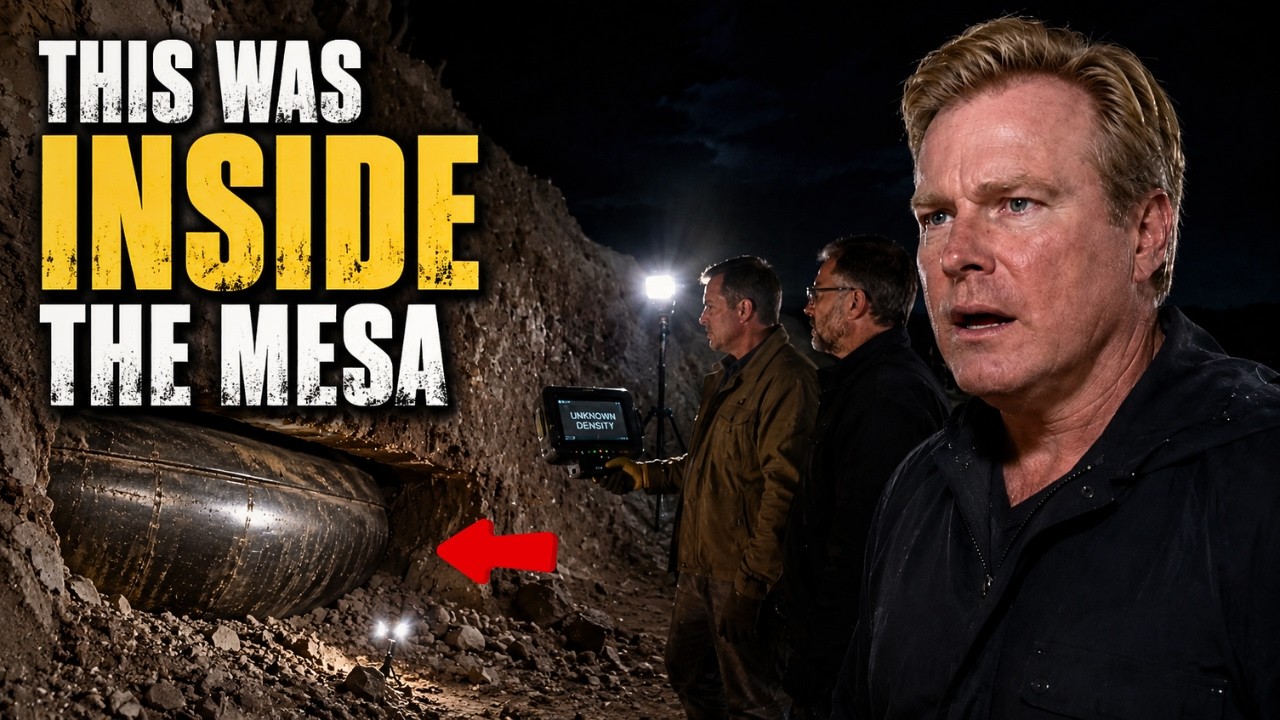
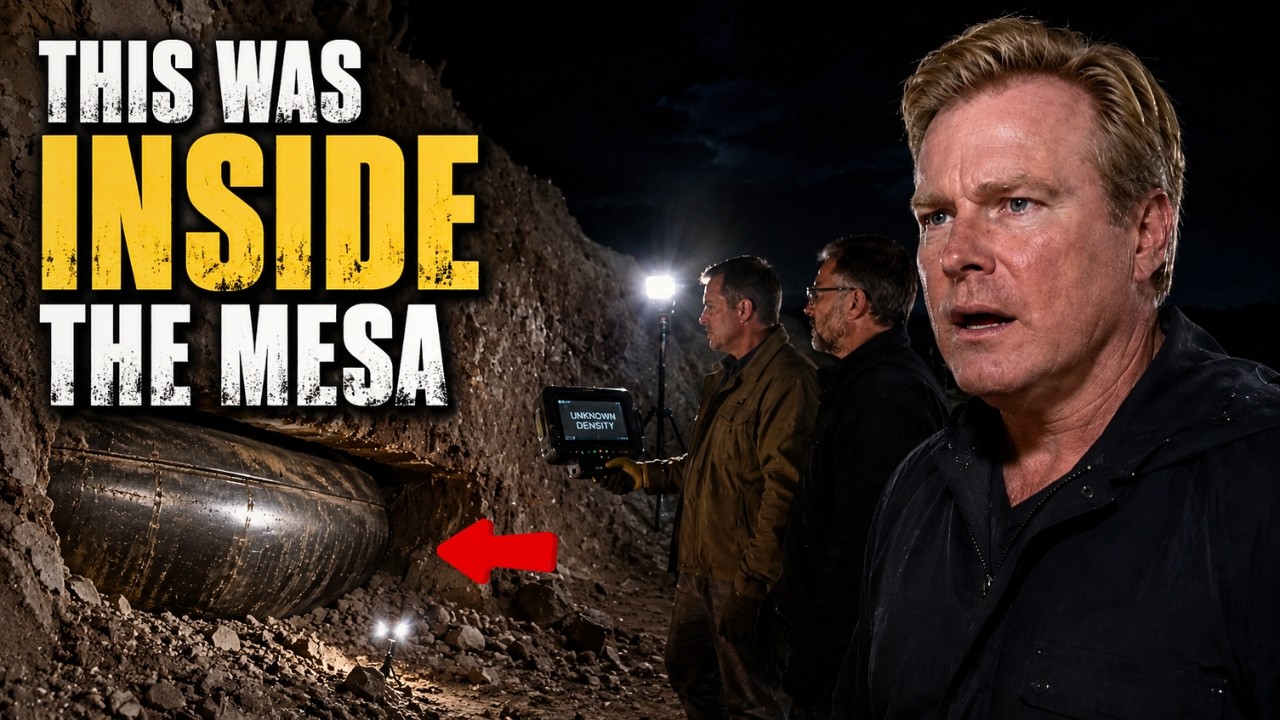
Regardless of the season, the equipment used, or the personnel conducting the survey, imaging repeatedly suggested the presence of an unusually dense underground structure beneath the mesa.
Independent operators working with different instruments reported similar results.
It was not one mysterious reading but years of overlapping data that ultimately justified launching a multi-season drilling project.
The team’s objective appeared straightforward.
If the anomaly existed, drilling would either confirm its presence or demonstrate that earlier readings had been misleading.
Neither outcome occurred.
Instead, the excavation produced an entirely different mystery.
When the Drill Met Resistance
As the borehole approached the depth where radar had indicated the anomaly, drilling behavior changed dramatically.
According to crew members, the drill no longer appeared to be cutting through ordinary rock.
Brand-new tungsten carbide drill bits—designed specifically for penetrating extremely hard geological formations—began wearing down within minutes.
Instead of breaking or chipping, their cutting edges returned smooth and rounded, as though they had been polished against a material significantly harder than themselves.
One bit failed.
Then another.
Then a third.
Geologists initially proposed that the drill had encountered an exceptionally dense basalt intrusion.
The explanation seemed reasonable.
Until the drilling data arrived.
Operators monitoring the drill string reported forces that appeared to push the drill downward before reversing direction and forcing it upward under pressure.
Ordinary basalt resists drilling.
It does not actively redirect a drill string.
The observations challenged conventional expectations and left engineers searching for alternative explanations.
Unusual Material in the Drill Spoils
The damaged drill bits were not the operation’s only unexpected result.
Earlier stages of excavation had already produced an unusual greenish-pink gel-like material mixed with charcoal and partially burned plant matter.
Researchers noted that such organic material was difficult to reconcile with the known geological history of the surrounding sandstone at that depth.
While the substance has not been conclusively identified, its presence added another unexplained element to an investigation already marked by anomalies.
Unlike unusual radar readings or eyewitness accounts, however, damaged drill bits represented something tangible.
They could be photographed.
Measured.
Tested.
The question became increasingly difficult to ignore:
What kind of material could rapidly wear down industrial cutting equipment while appearing alongside unexpected organic matter hundreds of feet underground?
Laboratory Results Deepen the Mystery
To avoid relying solely on internal analysis, the recovered fragments were submitted to an independent materials laboratory.
The report arrived in measured, technical language.
Microscopic examination revealed a layered internal structure displaying remarkable consistency rather than random fracture patterns.
Researchers noted similarities between portions of the material and protective coatings used in certain aerospace applications, particularly thermal shielding designed to withstand extreme temperatures.
The report did not conclude that the fragments originated from aerospace technology.
It merely documented similarities in structural characteristics.
A second finding attracted even greater attention.
Several samples produced measurable, low-level radioactive readings.
The laboratory repeated the measurements using separate instruments before confirming the results.
The radiation levels were not considered dangerous.
They were simply higher than expected.
Even so, geologists urged caution.
Certain mineral formations can naturally produce layered structures that resemble manufactured materials.
Nature is capable of creating surprisingly complex patterns through pressure, mineralization, and time.
The evidence, therefore, remained open to interpretation.
One group viewed the material as potentially engineered.
Another regarded it as an unusual but natural geological formation.
Neither explanation fully accounted for every observation.
Darkness Inside the Borehole
While laboratory analysis continued, another experiment produced unexpected results.
Researchers lowered a specialized borehole camera nearly 240 feet underground.
The camera was housed inside a sealed pressure-resistant casing and equipped with powerful illumination specifically designed for low-light environments.
Yet the live video feed displayed almost complete darkness.
Not grainy.
Not poorly focused.
Simply black.
At irregular intervals, tiny points of light briefly appeared before disappearing again.
The investigation’s physicist suggested one possible explanation.
Gamma radiation striking the camera’s imaging sensor can occasionally create bright pixels or flashes.
Such effects are known in radiation-rich environments.
Whether that mechanism fully explained the observations remained uncertain.
Signals That Should Not Exist
At the surface, electronic monitoring equipment detected another anomaly.
During active drilling, a spectrum analyzer began recording radio-frequency signals near 1.2 GHz and 1.6 GHz.
One of those frequencies closely matched the beacon normally used to track the drill head underground.
There was one problem.
According to operational logs, the beacon had been powered off at the time the signal appeared.
Investigators have not determined what produced the transmission.
Unlike anecdotal reports, these observations came from calibrated electronic instruments recording measurable data.
Whether the signals resulted from equipment malfunction, environmental interference, or another unidentified source remains unresolved.
A Coin from 1964
Among thousands of pounds of excavated material, one ordinary object proved especially intriguing.
At approximately 496 feet, technicians recovered a 1964 United States nickel.
Elsewhere, such a discovery might have attracted little attention.
Here, it raised difficult questions.
If the coin genuinely originated from that depth rather than being introduced through another mechanism, it could suggest that the ground had been disturbed sometime after 1964.
Researchers immediately began reviewing historical records.
Aerial photographs from 1969 covering the site appeared to show irregularities that prompted closer examination.
More surprising still, investigators reported difficulty locating aerial or satellite imagery covering the area between 1964 and 1968.
Whether those records were never created, misplaced, classified, or lost remains unknown.
No publicly documented explanation has resolved the apparent gap.
A Pattern Without a Conclusion
Viewed individually, each observation has at least one plausible explanation.
Radar anomalies can reflect unusual geology.
Layered minerals can resemble manufactured materials.
Radioactive minerals occur naturally.
Electronic interference can generate unexpected signals.
Coins may be displaced through drilling processes.
Yet researchers argue that the accumulation of anomalies has become increasingly difficult to explain through any single theory.
Years of radar data.
Repeated drill-bit failures.
Layered radioactive fragments.
Unexpected radio signals.
An unexplained camera blackout.
A decades-old coin.
An incomplete historical record.
Together, they form a pattern that remains unresolved.
The Investigation Continues
As of the latest phase of research, drilling continues between the original boreholes in an effort to reach greater depths while avoiding previously encountered obstructions.
No recovered material has been conclusively identified.
No definitive source has been established for the unexplained radio signals.
No consensus exists regarding the borehole camera observations or the recovered coin.
For investigators, uncertainty remains the defining characteristic of the project.
Perhaps the most intriguing question is not the nature of the fragments or the resistance encountered by the drill.
It is the historical gap surrounding the site.
According to researchers, aerial imagery covering several critical years appears to be absent from the available archive.
Whether that absence reflects coincidence, routine record loss, or something more deliberate has yet to be determined.
Until additional evidence emerges, the mystery beneath the Utah mesa remains exactly that—a mystery.
Rather than delivering definitive answers, every new layer of excavation seems only to expose deeper questions.
And somewhere below the drill, the unknown still waits.