The Mystery Beneath Skinwalker Ranch: What Lies Under Utah’s Desert?
Just after midnight on a quiet mesa in Utah’s Uinta Basin, a ground-penetrating radar scan revealed something that immediately caught the attention of researchers. Instead of the irregular patterns normally associated with natural rock formations, the instrument displayed a remarkably straight, flat feature buried about 15 feet beneath the surface. One technician reportedly remarked, “That’s not supposed to be there.”
The discovery reignited one of the longest-running mysteries associated with Skinwalker Ranch, a 512-acre property that has attracted scientists, geologists, engineers, and government-funded researchers for nearly three decades. While the ranch is widely known for reports of unexplained phenomena, this particular investigation focused on something far more tangible: an unusual underground structure that has resisted easy geological explanation.
A Suspicious Hollow Beneath the Mesa
Long before sophisticated radar equipment arrived at the ranch, one technician who worked on the property every day had noticed something unusual. Whenever he crossed one particular section of the mesa, the ground seemed different. It sounded hollow beneath his feet, almost as though an empty chamber lay underneath.
At the time, he had no instruments to support his observation. It was simply an instinct developed through years of walking the same terrain. Years later, when survey teams mapped the property using modern geophysical equipment, the radar identified an underground void almost exactly where the technician had sensed something unusual.
Although coincidence cannot be ruled out, the agreement between human observation and later scientific measurements encouraged researchers to investigate further.
What the Radar Revealed
Ground-penetrating radar works by sending electromagnetic waves into the earth and measuring the reflections from underground layers. During multiple surveys, investigators consistently detected what appeared to be a long underground cavity approximately 15 feet below the surface.
The feature displayed several characteristics that immediately drew attention:
- a flat, level roof;
- a relatively constant width;
- a remarkably straight path;
- little evidence of the irregular collapse normally associated with natural caves.
Researchers compared the radar data with known geological formations throughout the Uinta Basin.
The most obvious explanation was a collapsed lava tube.
However, lava tubes generally curve, vary in width, and collapse unevenly over thousands of years. The radar images beneath Skinwalker Ranch appeared considerably more uniform than typical examples.
That observation did not prove the feature was artificial—it simply meant that the simplest geological explanation was not entirely satisfactory.
Searching for Natural Explanations
Geologists proposed several possible origins:
- a collapsed lava tube;
- an erosion channel;
- a sinkhole;
- an abandoned mining tunnel.
Each hypothesis had some geological precedent within Utah.
However, none fully explained the unusual geometry seen on the radar images.
Scientists emphasized that unusual does not necessarily mean artificial. Nature occasionally produces formations that appear surprisingly regular. Nevertheless, no comparable structure had been documented in the surrounding basin.
The unanswered question became:
If this is natural, why hasn’t anything similar been found nearby?
An Unexpected Historical Clue
While reviewing historical land records, one researcher discovered a survey dating from the 1930s.
Among the faded notes was a brief handwritten warning marking the same area as “unstable.”
The surveyors of that era had no radar or modern imaging technology.
The notation did not identify any underground structure, nor did it explain why the area was considered unstable.
Still, researchers found it noteworthy that the warning corresponded closely with the location later identified by modern radar.
By itself, the document proved nothing.
But it suggested that something unusual about this section of land may have been recognized decades before electronic surveys existed.
Independent Surveys Reach Similar Results
Years after the original radar scan, a different survey team returned with newer equipment.
Importantly, the technicians conducting the work reportedly had no knowledge of the earlier findings or the old land survey.
When their data were compared with previous scans, the results aligned remarkably well.
Both teams identified:
- nearly identical depths;
- similar widths;
- the same straight underground feature.
In geophysical investigations, independent measurements that produce similar results significantly reduce the likelihood of simple equipment error.
However, consistency does not automatically reveal the nature of the structure.
The mystery remained.
Looking Inside
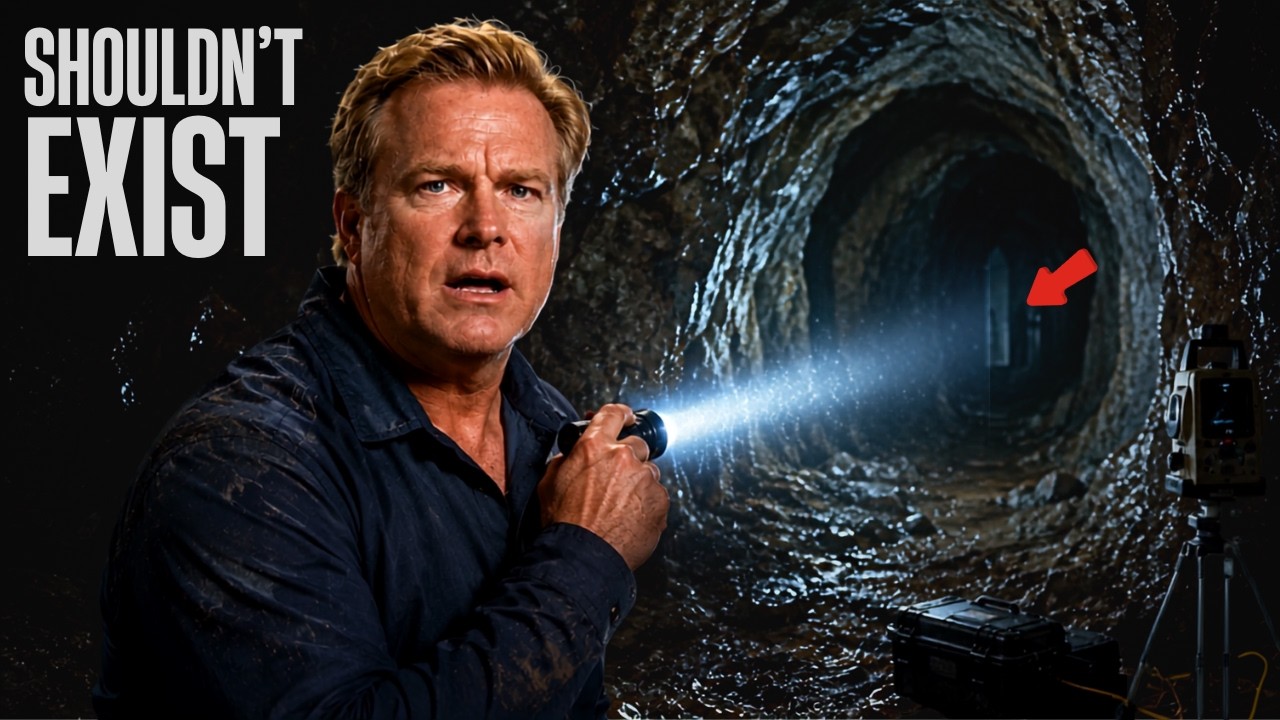
To learn more, investigators drilled a borehole and lowered a camera into the void.
The first camera transmitted images for less than a minute before its signal failed.
Assuming equipment malfunction, the team deployed a second, more robust camera.
This unit survived slightly longer and captured several seconds of video before it too stopped transmitting.
The brief footage showed rough rock walls that differed from what some geologists expected to see inside a lava tube.
Typically, lava tubes possess smoother interior surfaces created by flowing molten rock.
The observed textures appeared more irregular.
The video was too limited to support firm conclusions, but it provided additional reason for some researchers to question the lava tube hypothesis.
Government Interest
Public attention toward Skinwalker Ranch increased after reports emerged that the U.S. government’s Advanced Aerospace Threat Identification Program (AATIP) had, at one point, examined activities associated with the property.
The program’s broader purpose involved investigating reports of unexplained aerial phenomena.
Its involvement with the ranch has often been cited as evidence that officials considered the location worthy of further study.
However, government interest should not be interpreted as confirmation of extraordinary claims.
Government agencies frequently investigate locations or reports precisely because questions remain unanswered.
Scientific Disagreement
Not all experts interpreted the evidence the same way.
One experienced geophysicist argued that the underground feature was most likely an unusual—but entirely natural—rock formation.
Another consultant disagreed, suggesting that the structure’s geometry did not closely resemble documented volcanic formations within the region.
Both scientists examined essentially the same radar data.
Yet they reached different conclusions.
Their disagreement illustrates an important aspect of scientific research: identical evidence can sometimes support multiple competing interpretations until additional data become available.
Comparing Old Incident Maps
Researchers later overlaid the radar images onto historical maps documenting decades of reported anomalies across the ranch.
Some sections of the underground feature appeared to coincide with locations where unusual events—such as unexplained lights or sensor malfunctions—had previously been reported.
The overlap attracted interest.
However, investigators were careful not to overstate its significance.
Correlation does not establish causation.
The maps were created independently and for different purposes.
Whether the apparent alignment represents meaningful evidence or simple coincidence remains unknown.
Testing the Lava Tube Theory
To evaluate the volcanic explanation more directly, geologists performed seismic refraction surveys.
This method measures how seismic waves travel through underground materials.
If the buried structure were a conventional collapsed lava tube, researchers expected the seismic data to display recognizable patterns.
Instead, the results proved inconclusive.
The data neither confirmed nor completely rejected the hypothesis.
Similarly, comparisons with known lava tubes elsewhere in the Uinta Basin revealed noticeable differences.
Most documented lava tubes taper and change shape over distance.
The feature beneath the mesa appeared comparatively consistent.
Again, this did not eliminate natural explanations, but it weakened confidence in the simplest one.
A Third Possibility
As natural explanations became increasingly difficult to confirm, some researchers cautiously discussed another possibility.
Perhaps the underground feature had been modified at some point rather than formed entirely by natural processes.
This idea could potentially explain the straight geometry and relatively flat roof.
However, supporters of this hypothesis acknowledged a critical limitation.
No direct evidence currently supports it.
No construction materials have been recovered.
No tool marks have been documented.
No core samples demonstrate artificial engineering.
Without physical evidence, the suggestion remains speculative.
Scientists involved in the investigation consistently emphasized that there is no confirmed evidence the structure was built by humans or by any other intelligence.
Likewise, they noted that the possibility cannot yet be completely excluded because only a small portion of the feature has been examined.
Extending the Survey
Researchers later expanded the radar survey beyond the limits of earlier scans.
The underground feature appeared to continue farther than previously recognized.
Eventually, the radar signal weakened beyond the equipment’s effective range.
Importantly, the signal did not clearly terminate.
Instead, investigators simply reached the technological limits of detection.
When projected onto property maps, the apparent underground path extended toward several locations associated with historical reports of unusual activity and seemed to continue beyond the ranch’s property boundary.
Whether the structure truly extends farther remains unknown.
Only excavation or more advanced imaging could answer that question.
An Unfinished Investigation
Nearly thirty years after formal scientific investigations began, Skinwalker Ranch continues to generate debate.
Researchers have accumulated radar data, seismic surveys, historical documents, camera footage, and decades of field observations.
Some findings reinforce one another.
Others raise new questions.
Yet none provide a definitive explanation for the underground feature beneath the mesa.
At present, the most cautious scientific conclusion is also the simplest:
Researchers have identified an unusual underground structure that does not fit neatly within currently favored geological explanations. However, no evidence conclusively demonstrates that it is artificial, connected to reported anomalies at the ranch, or associated with any extraordinary phenomenon.
The mystery therefore remains unresolved.
Future investigations—including deeper drilling, core sampling, or direct exploration of the void—may eventually determine whether the formation is an uncommon product of geology or something entirely different.
Until such evidence is obtained, the underground feature beneath Skinwalker Ranch stands as an intriguing scientific puzzle—one that continues to invite investigation while resisting definitive answers.