Did Skinwalker Ranch Push Back? Inside the Investigation That Left the Team Questioning Everything
There are nights during an investigation when equipment fails, weather changes, or unexpected complications interrupt carefully planned experiments. Then there are nights that investigators remember for an entirely different reason—because something happens that refuses to fit neatly into any familiar explanation.
According to the account presented in this episode, one of those nights unfolded at Skinwalker Ranch.
It did not happen after the experiment ended.
It did not happen during post-production or while reviewing footage days later.
It happened in the middle of the investigation itself.
The team arrived with scientific instruments, calibrated sensors, cameras, radios, and a carefully designed experimental protocol. Their objective was straightforward: collect measurable evidence that might explain the unusual phenomena repeatedly reported across the property.
By the end of the night, however, many investigators were no longer asking only what they had observed.
They were asking whether the investigation itself had somehow changed the environment around them.
More Than Another Strange Night
Skinwalker Ranch has become synonymous with mystery.
For decades, reports have described unexplained lights, unusual aerial objects, equipment malfunctions, missing time, animal behavior, electromagnetic anomalies, and unexplained health symptoms experienced by visitors.
Because these stories have circulated for generations, public opinion often divides into two camps.
Some view the ranch as one of America’s most intriguing unexplained locations.
Others regard it primarily as folklore amplified by television.
What makes this particular investigation different is not simply another unusual reading.
Instead, the reported anomalies appeared to unfold around the investigation itself.
Rather than remaining distant observations, the unusual events seemed to move directly into the team’s operational space.
Whether that represented coincidence, environmental complexity, or something investigators had yet to understand became the central question of the evening.
Why Travis Taylor’s Reaction Matters
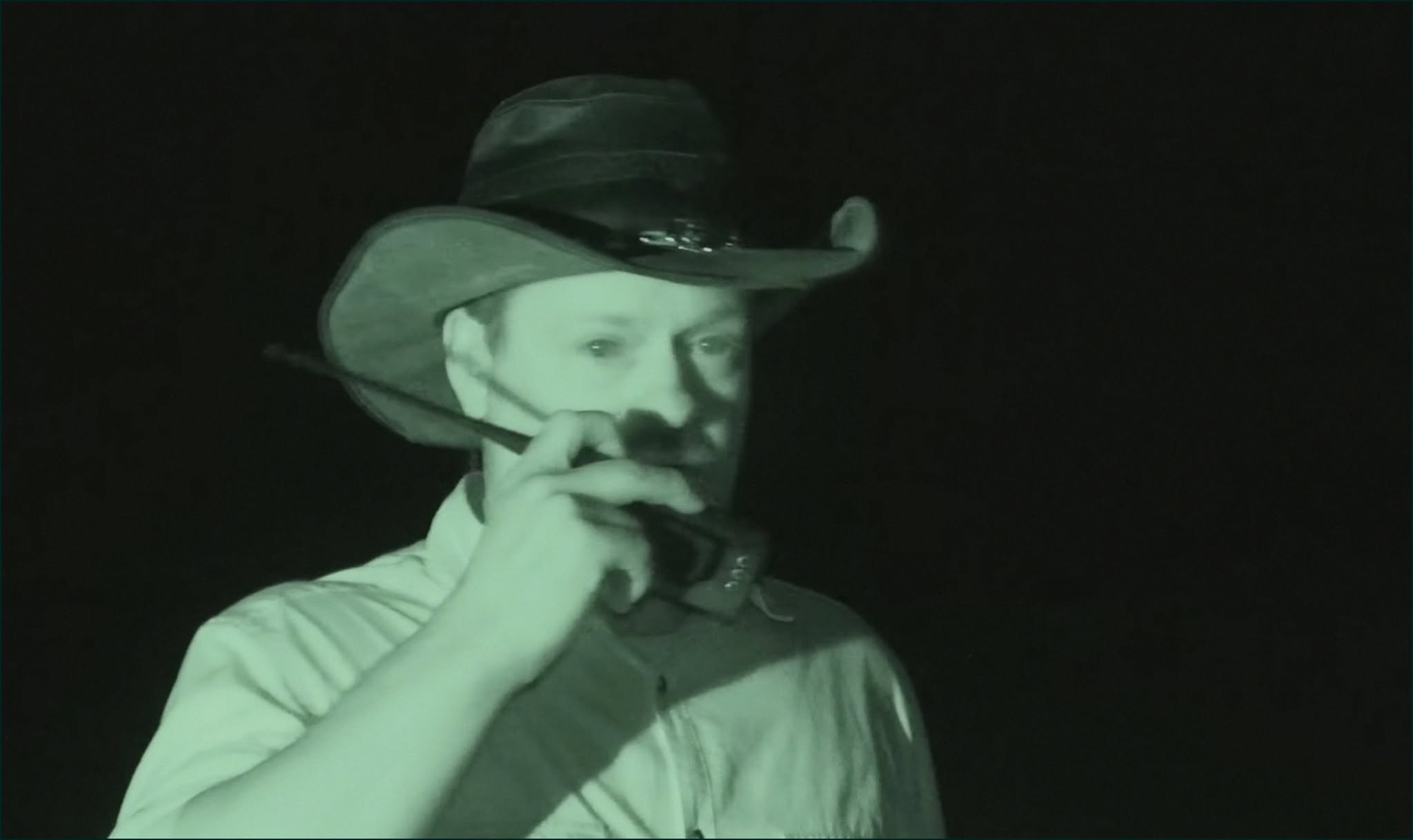
Much of the attention naturally focused on Dr. Travis Taylor.
Throughout the investigation, Taylor has consistently approached unusual claims with scientific caution rather than immediate belief.
His first instinct is typically to examine data.
He looks for repeatability.
He checks instrument calibration.
He searches for environmental variables capable of explaining unexpected measurements.
When radios fail, he looks for interference.
When sensors spike, he examines timing.
When someone reports feeling unwell, he considers environmental exposure before entertaining more extraordinary possibilities.
That methodology matters.
Scientists are trained not to confuse surprise with evidence.
For that reason, subtle changes in Taylor’s demeanor often attract more attention than dramatic reactions from others.
When someone committed to careful analysis appears increasingly concerned by the available data, observers naturally pay closer attention.
Not because concern proves anything unusual happened.
But because it suggests the available evidence may not fit existing expectations.
Small Irregularities Became a Pattern
According to the investigation, the evening did not begin with a dramatic event.
Instead, investigators described a gradual accumulation of small irregularities.
A reading drifted away from baseline.
Communication became less reliable.
A device produced inconsistent results.
None of these observations, by themselves, would necessarily indicate anything extraordinary.
Every field investigation experiences occasional equipment problems.
Environmental conditions change.
Electronics malfunction.
Sensors require recalibration.
Experienced investigators expect such complications.
What changes an investigation is not one anomaly.
It is multiple independent irregularities appearing close together.
As additional inconsistencies accumulated, the atmosphere reportedly shifted.
Crew members checked equipment more frequently.
Conversations became shorter.
Attention moved increasingly toward instrument displays rather than the surrounding landscape.
The investigation remained scientific.
But the level of caution clearly increased.
An Environment That Shapes Perception
The physical setting also influenced the investigation.
At night, Skinwalker Ranch presents an expansive and isolated landscape.
Open terrain stretches into darkness.
Artificial light becomes scarce.
Natural sound is minimal.
Such environments naturally heighten awareness.
Investigators recognize that psychological context matters.
Expectation can influence perception.
Stress can affect judgment.
That is precisely why experienced researchers attempt to distinguish emotional responses from measurable observations.
Yet Skinwalker Ranch has repeatedly presented situations where both appear simultaneously.
Investigators report unusual feelings.
At the same time, instruments record unexpected behavior.
That overlap complicates interpretation.
A Planned Scientific Experiment
Contrary to popular assumptions, the crew was not simply waiting for something unusual to happen.
The night’s work centered on a structured scientific experiment.
The team had identified a target.
Instrumentation had been deployed deliberately.
Measurements followed a predefined methodology.
This distinction is important.
Unexpected events occurring during casual observation are easier to dismiss as coincidence.
Unexpected events occurring precisely while a controlled experiment is underway naturally invite closer examination.
Whether the investigation itself somehow influenced subsequent observations remains unknown.
However, the timing became one of the night’s most discussed features.
When the Experiment Began to Change
Investigators have frequently noted a recurring pattern throughout previous seasons.
Whenever experiments become more focused, operational complications often appear.
Rocket launches experience unexpected tracking issues.
Electromagnetic measurements fluctuate.
Communications become unstable.
Baseline environmental readings shift.
None of these observations necessarily demonstrate causation.
Nevertheless, the repeated timing encourages continued investigation.
On this occasion, the reported disruptions appeared to accumulate rather than occur individually.
One irregularity followed another.
Together, they produced an increasingly uncomfortable question:
Was the team still controlling the experiment?
Or had environmental conditions begun influencing the investigation itself?
Equipment Is More Than Technology
In remote scientific fieldwork, equipment serves purposes far beyond simple convenience.
Radios maintain communication and safety.
Environmental sensors provide objective measurements.
Monitoring systems help distinguish perception from measurable reality.
When those systems become unreliable, investigators lose confidence in their situational awareness.
During this investigation, communications reportedly became less consistent.
Instrument readings fluctuated unexpectedly.
Crew members repeatedly verified observations using multiple devices.
Voices became more deliberate.
Procedures slowed.
These behavioral changes often reveal increasing operational caution long before anyone openly expresses concern.
Reports of Physical Effects
Perhaps the most sensitive aspect of the investigation involved reports of physical symptoms.
Over many years, visitors to Skinwalker Ranch have described headaches, dizziness, nausea, mental fog, unusual fatigue, and pressure sensations during certain investigations.
Importantly, each of these symptoms has many ordinary medical and environmental explanations.
Stress alone can produce remarkably similar experiences.
Long hours, dehydration, weather conditions, and fatigue may contribute as well.
Responsible investigators therefore avoid assuming unusual causes without supporting evidence.
However, when physical symptoms appear alongside instrument irregularities during a structured experiment, documenting them becomes scientifically appropriate.
The human experience becomes another observational dataset.
Not proof.
But information requiring careful analysis.
Balancing Science and Safety
As conditions reportedly became more complicated, investigators faced a familiar dilemma.
Should the experiment continue?
Or should safety take priority?
Every field investigation involves balancing scientific value against operational risk.
That balance becomes particularly important whenever uncertainty increases.
Throughout the episode, the team’s response emphasized caution rather than sensationalism.
Investigators continued gathering data while carefully evaluating whether changing conditions justified terminating the experiment.
Such decisions reflect standard scientific field practice regardless of whether anomalies ultimately prove unusual or entirely conventional.
Pattern Does Not Equal Proof
One of the episode’s strongest themes concerns recurring patterns.
Investigators noted that operational disruptions often seem to coincide with moments when experiments become most productive.
Patterns deserve attention.
However, patterns alone do not establish intentionality.
Environmental complexity, equipment limitations, and coincidence remain possible explanations.
Scientific investigation requires considering all plausible hypotheses simultaneously.
Several possibilities remain consistent with available information:
- unusual but natural geological processes,
- localized electromagnetic effects,
- atmospheric conditions,
- complex interactions between technology and environment,
- psychological influences operating alongside genuine instrument anomalies,
- or mechanisms not yet fully understood.
Maintaining multiple working hypotheses remains essential.
Could the Ranch Be “Responding”?
Perhaps the episode’s most provocative question concerns whether the environment somehow reacts when investigators intensify their efforts.
This idea is understandably compelling.
It is also extraordinarily difficult to demonstrate scientifically.
Timing alone cannot establish awareness or intent.
Even remarkably consistent timing may ultimately reflect natural environmental processes not yet fully understood.
Nevertheless, investigators acknowledged that repeated coincidence between focused experiments and operational disruption warrants continued study.
The important distinction is between asking the question and claiming to have answered it.
The investigation does the former.
It does not conclusively establish the latter.
After the Investigation
Once immediate concerns subsided, the work shifted from field observation to analysis.
Investigators reconstructed events minute by minute.
They compared timestamps across every available dataset.
They examined:
- communication logs,
- environmental sensor records,
- electromagnetic measurements,
- thermal data,
- crew locations,
- reported physical symptoms,
- and equipment performance.
This analytical process ultimately determines whether apparently related events genuinely correlate or merely occurred close together.
That work often continues long after cameras stop recording.
An Investigation Without Easy Conclusions
Perhaps the most honest aspect of the episode is its refusal to claim certainty where certainty does not yet exist.
The team did not present definitive proof that the ranch somehow “attacked” investigators.
Nor did they dismiss every unusual event as simple coincidence.
Instead, they documented a sequence of observations that collectively raised important scientific questions.
Why did multiple irregularities appear during a focused experiment?
Were the reported physical symptoms environmentally related?
Could instrument behavior be explained through conventional mechanisms?
Or do the observations suggest environmental processes that remain poorly understood?
Those questions remain open.
Looking Forward
Every season of the investigation has reinforced one consistent lesson.
Skinwalker Ranch rarely provides simple answers.
Instead, each experiment tends to produce new questions alongside new data.
This particular investigation follows that pattern.
The crew completed their work with more information than when they arrived.
They also left with greater uncertainty.
Whatever occurred during that night, it influenced not only the data collected but also the direction of future research.
Whether the events reflected unusual natural phenomena, complex environmental interactions, equipment limitations, psychological factors, or something not yet understood remains unresolved.
What is clear is that the investigation did not end with certainty.
It ended with careful documentation, continued analysis, and a renewed commitment to testing every observation against the strongest available scientific standards.
For now, the evidence remains under examination.
The questions remain open.
And the mystery of Skinwalker Ranch continues—not because definitive answers have been found, but because the available evidence still resists a single, complete explanation.