Oak Island’s Greatest Mystery Deepens: New Discoveries Revive the Search for Lost History
For more than two centuries, Oak Island, a small island off the coast of Nova Scotia, Canada, has captivated explorers, historians, and treasure hunters alike. Legends speak of an elaborate underground vault concealing unimaginable riches or priceless historical relics. While many have searched for gold, recent discoveries suggest that the island’s true secret may not be wealth at all—but knowledge, history, and perhaps one of humanity’s greatest lost treasures.
A Promising Discovery on Lot 25
The latest expedition began on Lot 25, near the former home of Samuel Ball, one of Oak Island’s most fascinating historical figures. Using his trusted metal detector, expert treasure hunter Gary Drayton uncovered what initially appeared to be a heavily corroded pocketknife.
Although worn nearly beyond recognition, the knife’s green corrosion indicated the presence of copper, explaining the strong detector signal. Marty Lagina immediately noticed that this was no ordinary tool. Instead, it appeared to be an elegant gentleman’s pocketknife, suggesting that its owner had enjoyed considerable wealth and status.
The discovery was especially significant because it was found on land once owned by Samuel Ball. Born into slavery, Ball later became one of the island’s wealthiest landowners, accumulating prosperity that historians have long struggled to explain. Every artifact recovered from his property raises new questions about the true source of his remarkable fortune.
Evidence of Wealth Hidden in Plain Sight
Only moments after uncovering the pocketknife, Drayton detected another metallic object buried nearby. This time, the team recovered a small metal plate engraved with the word “Patent.”
Experts quickly identified the artifact as part of an eighteenth- or early nineteenth-century firearm. Patent plates were commonly attached to muskets to protect unique mechanical innovations developed by gunsmiths.
Based on its distinctive lettering, Drayton estimated that the plate dated between 1790 and 1830, placing it squarely within Samuel Ball’s lifetime.
Such a finely crafted firearm component was unlikely to belong to an ordinary farmer. Instead, it hinted once again that Ball possessed considerable financial resources, reinforcing the long-standing theory that his wealth may have originated from activities never documented in historical records.
The Mystery of the Chappell Vault
While these discoveries were exciting, they also revived interest in one of Oak Island’s oldest and most mysterious discoveries.
In 1897, treasure hunter William Chappell drilled deep beneath the infamous Money Pit in search of a hidden chamber. During the operation, his drill penetrated a hard, cement-like layer believed to cover an underground vault.
When the drill emerged, it carried an extraordinary object: a tiny fragment of parchment.
The small piece of manuscript contained two inked letters—“V” and “I”—written in what appeared to be India ink.
The discovery stunned researchers.
How could a handwritten parchment have ended up approximately 153 feet underground, sealed inside what appeared to be an intentionally constructed chamber?
Unfortunately, before investigators could explore further, the surrounding ground collapsed. The suspected vault slowly sank deeper into the earth, taking its remaining secrets with it.
To this day, no one has successfully recovered what may still lie inside.
Could Shakespeare’s Lost Manuscripts Be Buried There?
One of the most intriguing theories comes from Norwegian researcher Petter Amundsen, who believes Oak Island may hide something even more valuable than treasure.
According to Amundsen, clues embedded within Shakespeare’s First Folio indicate that the playwright’s original handwritten manuscripts were deliberately hidden on Oak Island centuries ago.
His theory proposes that ten strategically positioned boulders across the island form symbolic markers connected to the Tree of Life, ultimately leading to a hidden vault.
One critical location—known as Mercy Point—lies beneath approximately six feet of water in Oak Island’s mysterious triangular swamp.
Although Amundsen and the team searched extensively, probing beneath the muddy water, they found no definitive evidence. Yet occasional hollow sounds beneath the swamp floor continued to fuel speculation that hidden chambers may still exist below.
The Ark of the Covenant: Fact or Fantasy?
As discussions continued beside the swamp, the conversation turned toward some of history’s greatest lost relics.
Among the possibilities mentioned were:
- Shakespeare’s original manuscripts
- Secret Rosicrucian documents
- The Holy Grail
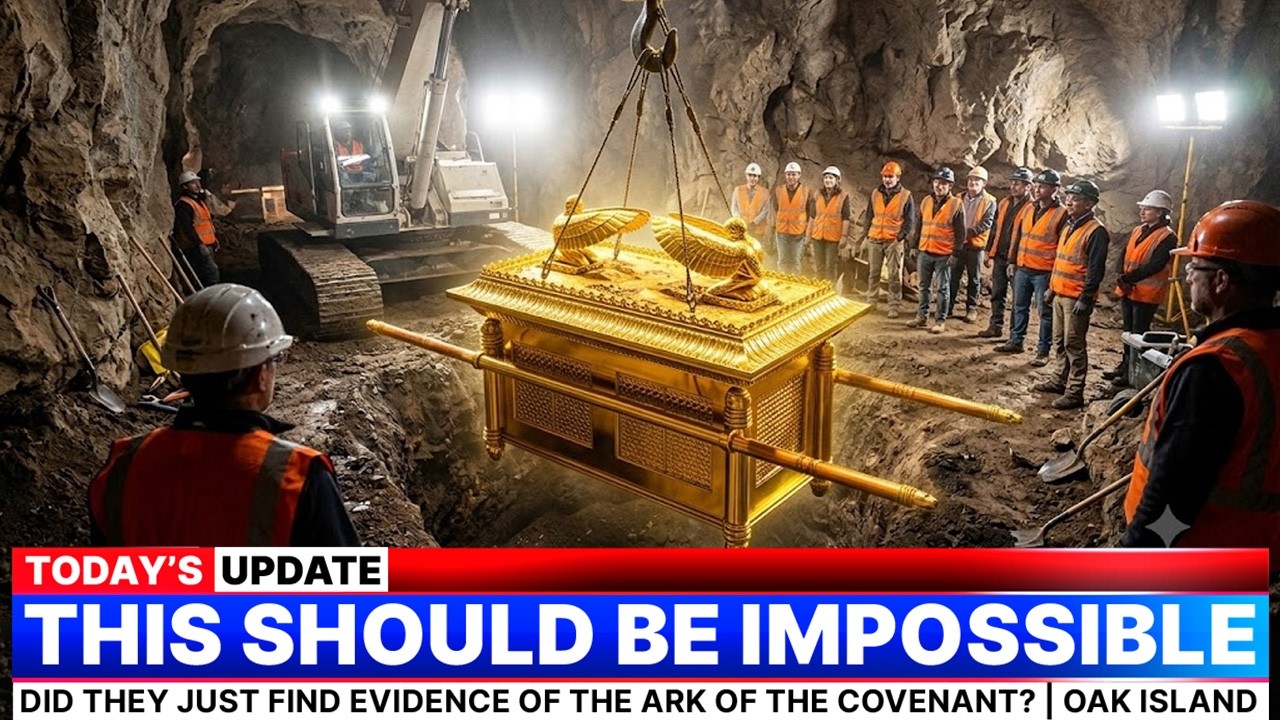
- The Ark of the Covenant
No one claimed that these artifacts had been discovered. Rather, the team acknowledged that if such an elaborate underground system truly existed, it was reasonable to ask what object could possibly justify such extraordinary efforts to conceal it.
One statement captured the imagination of viewers:
“The treasures the Templars supposedly possessed came from the Middle East. We need to do further testing, but at this moment, it’s an amazing find.”
Although far from proving the existence of biblical relics, the remark highlighted how every new discovery continues to expand the range of historical possibilities.
Searching for the Lost Ring Bolts
Attention later shifted to Oak Island’s eastern swamp, where Rick Lagina, Gary Drayton, Doug Crowell, and Steve Guptill searched for legendary iron ring bolts reportedly discovered decades earlier by researcher Fred Nolan.
Nolan believed these heavy iron rings had once been embedded in massive shoreline boulders, serving as docking points for a ship deliberately hidden within an artificial swamp.
If true, the implications would be extraordinary.
The team carefully searched the area, eventually uncovering a large cast-iron fragment.
Rather than disappointment, the discovery generated excitement.
Metal expert Carmen Legge later suggested that the fragment likely belonged to an old ship’s stove, consistent with additional stove pieces previously recovered by Nolan.
The possibility that remnants of a seventeenth-century vessel still remain near the swamp strengthens the argument that Oak Island may once have served as the hiding place for an intentionally concealed ship.
Confirming Fred Nolan’s Ancient Dump Site
The expedition continued on Lot 12, where Fred Nolan had previously identified what he believed was an ancient refuse dump.
Excavation quickly revealed exactly what Nolan had predicted.
Researchers uncovered numerous fragments of pottery alongside handmade square nails dating back centuries.
Rather than isolated artifacts, the trench exposed an entire debris layer containing broken ceramics and iron objects discarded long ago.
The discovery was important because it confirmed Nolan’s historical records and provided archaeologists with a reliable context for future dating.
If laboratory analysis determines that these artifacts originated during the construction period of the original Money Pit, they could finally reveal who was active on Oak Island during its earliest mysterious phase.
Could the Greatest Discovery Still Lie Underground?
Despite recovering numerous historical artifacts, the central mystery remains unsolved.
The swamp continues to behave as though it was engineered rather than naturally formed.
The Chappell Vault still lies somewhere beneath the surface.
Ship fragments continue to emerge.
Samuel Ball’s unexplained wealth remains a historical puzzle.
Every new artifact appears to strengthen rather than weaken the belief that something extraordinary once existed beneath Oak Island.
Whether the island ultimately conceals lost Shakespeare manuscripts, secret medieval documents, priceless religious relics, or simply evidence of forgotten history, researchers agree that each discovery brings them one step closer to understanding one of the world’s greatest archaeological mysteries.
For now, the soil continues to guard its secrets—but with every excavation, those secrets seem increasingly close to coming to light.