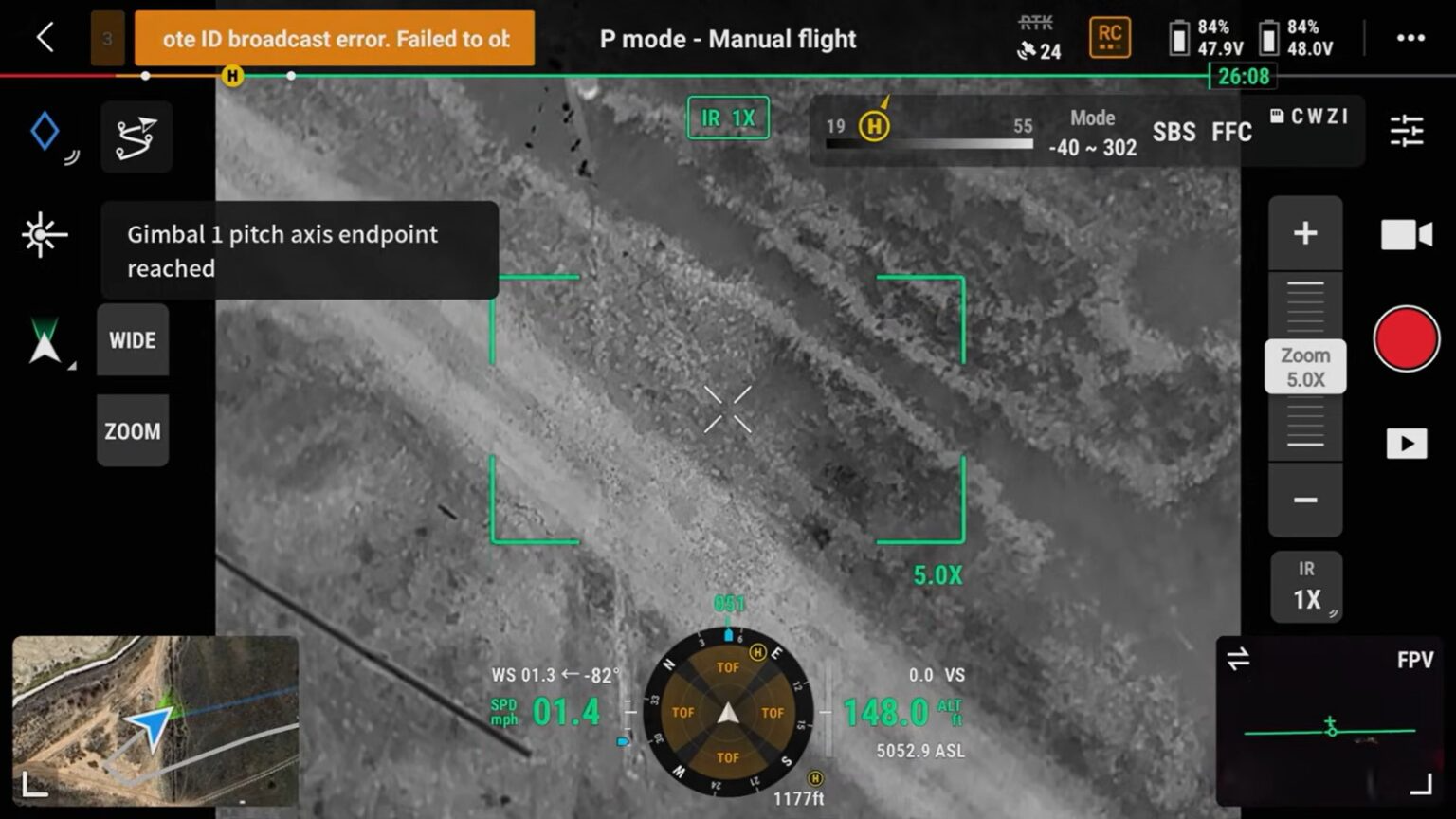
The high-altitude drama at Utah’s Uintah Basin reached an absolute breaking point in Season 7, Episode 12 of History Channel’s The Secret of Skinwalker Ranch, appropriately titled “Hot Pursuit.” In what was heavily promoted as the most aggressive aerial encounter in the show’s history, astrophysicist Dr. Travis Taylor and the field team ordered a chartered commercial helicopter to initiate a high-speed interception of an unidentified anomalous phenomenon (UAP) moving across the airspace directly above the “Triangle.”
During a night-time experiment involving a swarm of LED-equipped drones and high-output laser beams designed to stimulate the atmospheric boundary, ground cameras tracked a fast-moving, luminous orb descending from the upper atmosphere. On camera, Dr. Taylor barked orders over the radio frequency, urging the helicopter pilot to push the aircraft to its operational limits to intercept and film the unknown object at close range.
To millions of prime-time television viewers watching the episode unfold, the high-speed pursuit felt like an undeniable, historic confrontation—a real-time dogfight between human aviation technology and an advanced, non-human intelligence maneuvering in the night sky.
However, aviation safety experts, commercial rotorcraft pilots, and optical physicists are stepping forward to provide a thorough, sobering technical breakdown of the sequence. Their analysis exposes the extreme physical hazards and fundamental flaws of attempting an aerial intercept with a civilian helicopter.
To understand why this “hot pursuit” was aerodynamically impossible, one must first analyze the flight performance limits of a commercial light helicopter—such as an Airbus H125 or Bell 407—operating in high-altitude desert terrain. Skinwalker Ranch sits at an elevation exceeding 5,100 feet above sea level. At this altitude, the air density is significantly lower than at sea level, reducing rotor blade lift efficiency and engine shaft horsepower.
A commercial helicopter operating under these environmental conditions has a hard, mathematically defined maximum cruise speed (known in aviation as $V_{NE}$, or Never-Exceed Speed) of approximately 130 to 140 knots (roughly 150 mph). Attempting to “chase” a light source that is maneuvering across vast distances in three-dimensional airspace requires continuous high-bank turns and aggressive collective pitch adjustments.
When a pilot executes a sharp, high-speed bank turn at night in a high-altitude desert environment, the aircraft experiences rapid physical g-load increases and severe rotor tip stall dynamics. Furthermore, judging the exact distance, speed, and physical size of an ungrounded light source against a pitch-black night sky is an optical impossibility due to a well-documented neurological condition known as the autokinetic effect.
The autokinetic effect occurs when the human eye stares at a single point of light in a featureless dark background. Without visual reference points (such as buildings, horizon lines, or mountains), the human brain creates the illusion that the stationary or slow-moving light is rapidly darting, accelerating, or hovering erratically.
The helicopter pilot was not closing the distance on an advanced extraterrestrial craft operating under non-Newtonian propulsion; the aircraft was flying aggressive, high-risk maneuvers against a distant, slow-moving atmospheric light source—such as a commercial airliner, a low-Earth orbit satellite, or a high-altitude military drone—whose speed and distance were completely miscalculated by the ground team.
By encouraging a civilian pilot to execute high-speed nocturnal maneuvers in high-altitude desert air to pursue an unverified optical reflection, the production crew didn’t capture proof of an alien craft. They risked an aviation disaster purely to generate heart-pounding television footage, proving once again that dramatic prime-time storytelling always takes precedence over basic flight safety physics.